Tucker Hockey Tips
Consistent vs.
Reactive Development
Published on December 16, 2021
We are what we repeatedly do – excellence then – is not an act – but a habit. – Aristotle
The dictionary meaning of development is the act or process of growing or causing something to grow or become larger or more advanced over a period of time.
Too often in hockey, players get cut from a desired team and do not reach their goals. Unfortunately, many players and parents realize too late that extra development was certainly needed to reach and play at this higher level of the game.
Over the years, I have received many phone calls and emails from parents inquiring about extra skill development; mostly to improve their son’s or daughters skating ability after not making a certain team.
This is a reactive development approach.
Advancing up the hockey pyramid becomes more challenging and competitive at each higher level of play. Just because a player played U9 Division 1, there’s no guarantee he or she will play U11 Division 1 etc. Being a good skater at U9 may not be good enough for the U11 level! Continuous growth is critical for long term player advancement.
Players have to do the reps. Repetition is king! There are no shortcuts to “sweat equity” for success. The 10,000 hour rule is a benchmark to master skills and become expertly skilled in any chosen field of endeavour. Hockey players must put in the extra hours; love to train, want to get better and put in their extra time. It must feel like a joy not boring work! Players must be dedicated to the process not just hoping to get to their desired destination. Otherwise, they will often end up being extremely disappointed.
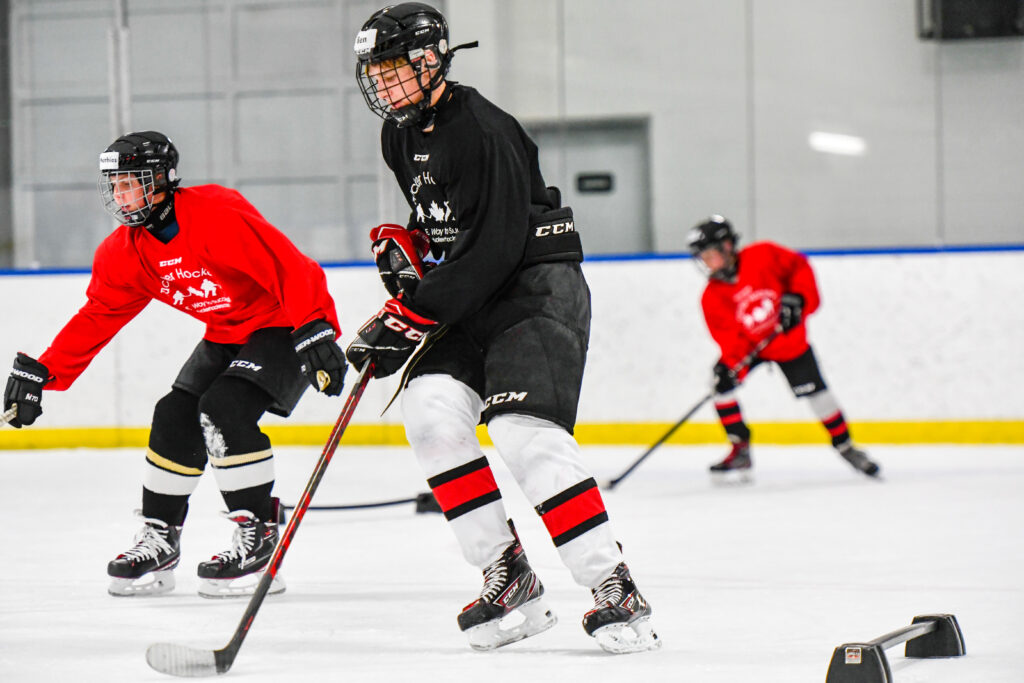
With consistent development, players work on their skills and hone their craft on a regular basis not just within their regular season minor hockey team and minor coaches. Player’s want to get better – it’s not just their parent’s desire. Really the player drives the “development bus” especially in the teenage years, whereas parents are the facilitators / supporters. Parents provide the financial support and hire on a well respected / knowledgeable power skating and / or hockey skills coach. The coach’s role is to take the player’s game to another level of development. For example, doing 1 extra hour of skills development a week i.e. 30 hours over a regular hockey season for 5 seasons equates to 150 hours of extra development which could possibly start from U11 and continue to U15 and beyond.
This extra development will certainly help improve the odds of advancing out of community hockey to more competitive city quadrant and / or CSSHL levels.
This is proactive consistent development approach.
It’s over a longer period of time – not just a short term bandage fix solution.
Here are a couple examples of incredible players at the NHL level who have believed in consistent development throughout their hockey careers.
Sidney Crosby during his NHL rookie season scored 100 points. It was a tremendous accomplishment. But he wasn’t satisfied. Not at all! In the off season, he worked diligently on his faceoff skill techniques and strengthened his backhand shot to make it as good as most players’ forehand shot. In addition, he advanced his down low puck protection skills to become – “A Beast” – the best in the world at protecting the puck! Every year and every practice Crosby is working continuously on his game. That’s why he is projected to finish his career rated in the top 5 all time players who have skated in the NHL.
Yes, Connor McDavid is truly gifted with incredible god given natural talent. But Connor has dedicated the time and effort during his teen years to develop quick feet and quick hands. It did not happen without a tremendous amount of passion for hockey, countless repetitions and drive – a personal commitment to hockey excellence.
Love the game – love to train – love to learn – love to improve – love to excel – love to pursue excellence. These are the core traits of consistent development.
How lofty are your hockey goals? How bad do you want something?
The higher the goal the more effort, commitment of hours and “sweat equity” are required to achieve future success.
- Train to Learn Fundamentals
- Train to Compete
- Train to Win
- Train to Excel
- Train to Master
If you want to get really good at anything in life you have to do the reps; unfortunately there are no shortcuts.
Hard work beats talent when talent doesn’t work hard!
~Coach Rex